

- Italian Crowdinvesting Between 2025 and 2025
- Crowdfunding Platforms in Italy
- The Reasons Behind the Decline in Italian Crowdinvesting
- What Are the Prospects for Crowdinvesting in Italy?
- Want to learn more directly with our crowdfunding experts about the topic you are reading about?
- Do you need support in preparing a successful crowdfunding campaign and seeking potential investors for your project?
In July, as it does every year, the Report from the Crowdinvesting Observatory from the Polytechnic University of Milan, which captures the The State of Equity, Lending, and Debt Crowdfunding in Italy.
Once again this year, the report notes a market decline This trend is now well established, as this marks the third consecutive year of increasingly steep declines.
The decline affects nearly all segments, though not to the same extent. Equity crowdfunding continues to be driven by real estate transactions, while campaigns targeting other businesses—including innovative startups—have fallen to record lows. Lending crowdfunding is also posting its lowest results in the last five years, while the placement of minibonds through platforms remains a marginal market.
To understand the extent of this decline, it is therefore necessary to examine the various instruments, the sectors being financed, the issuing companies, and the evolution of the platforms separately. Only in this way is it possible to distinguish the economic difficulties come on structural problems which are reducing the capacity of the Crowdfunding in Italy to attract businesses and investors.
Italian Crowdinvesting Between 2025 and 2025
The most striking figure in the 2026 report is the total revenue of 164.19 million euros recorded between July 2025 and June 2026. Compared to the previous survey, there were nearly 96 million euros, a much sharper decline than those observed in previous fiscal years: –36.8%.
The historical chart published by the Polytechnic shows nearly continuous growth from 2020 through the second half of 2022, when the half-yearly revenue had exceeded the 160 million euros. Volumes remained high in 2023 as well, before beginning to decline in 2024. The decline became much more pronounced in 2025 and brought the volume for the first half of 2026 to just above the levels seen in the first half of 2020.
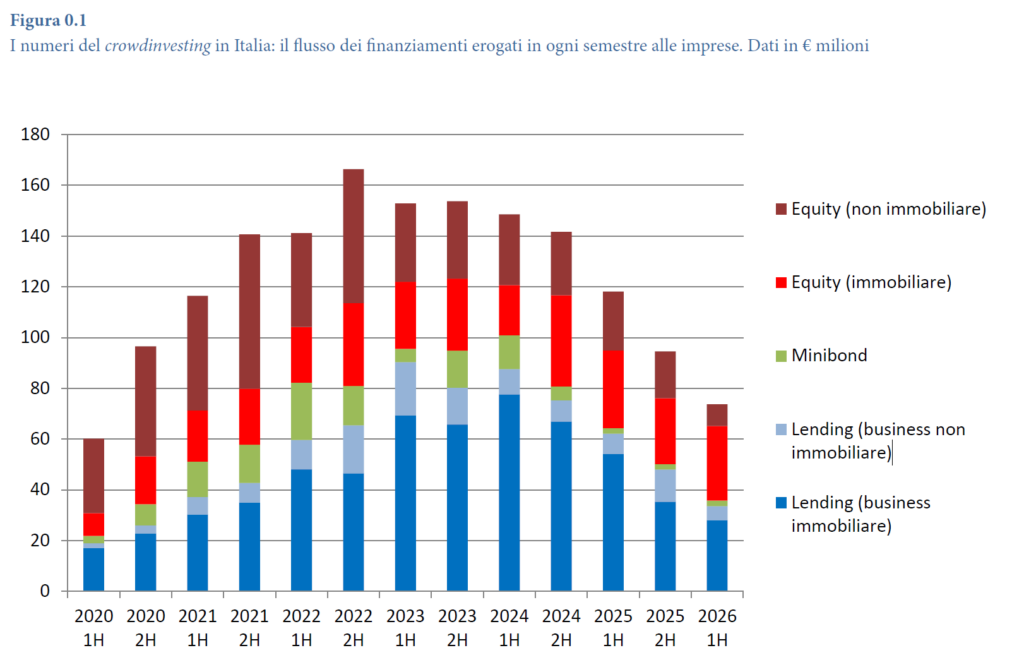
A historical comparison also highlights a shift in the market’s composition. During periods of strongest growth, funding was more broadly distributed among real estate lending, general lending, and non-real estate equity. In 2026, however, The market is increasingly dependent on real estate transactions, particularly equities, while the other sectors have gradually declined.
What makes this a structural phenomenon, therefore, is not only the magnitude of the decline, but its widespread occurrence across various sectors.
Equity Crowdfunding: Real Estate Supports a Struggling Market
Between July 1, 2025, and June 30, 2026, successfully completed equity crowdfunding campaigns raised a total of 82.37 million euros with a total of 114 successfully completed campaigns. Compared to the previous twelve months, fundraising decreased by approximately 28%.
But this is just the big picture. If you take a closer look, you’ll notice that the equity market appears increasingly divided into two segments with different trends. Real estate transactions continue to attract investors and large sums of money, while fundraising campaigns by startups and companies in other sectors are showing a much steeper decline.
Non-Real Estate Equity Crowdfunding
Non-real estate equity campaigns raised 26.96 million euros between July 2025 and June 2026, with a decrease of approximately 44% compared to the previous twelve months.
The average reach of non-real estate campaigns published during the period was 178,479 euros. Excluding investment vehicles as well, companies offered, on average, the’8,23% of capital, compared to a pre-money valuation an average of 3.38 million euros.
Content Collection Objectives They can help reach the minimum threshold during a period of reduced investor interest. At the same time, however, they leave companies with fewer resources to finance their development plans and risk resulting in a less-than-favorable ratio between the funds to be invested in the crowdfunding campaign and the net proceeds actually raised from the campaign.
La investor skepticism It also stems from the fact that, in general corporate fundraising campaigns, returns are tied to the company’s future growth, the distribution of profits, or the occurrence of an exit. Timelines and results are difficult to predict, especially when the issuer is a startup with no track record of economic and financial performance.
Real Estate Equity Crowdfunding
During the same period, real estate equity campaigns raised 55.41 million euros, with a decline of 16,6% compared to the previous twelve months, much more modest than that observed in non-real estate transactions.
The real estate sector generated approximately two-thirds of total equity fundraising, even though they account for only a quarter of the published listings. The difference stems from the size of the listings: the average size of real estate transactions was 978,846 euros, more than five times that of non-real-estate campaigns.
This greater stability can be attributed to the structure of these transactions. A real estate campaign typically finances a specific project—such as the purchase, construction, or renovation of a property—and specifies an expected duration and a monetization strategy clear. The investor can therefore evaluate a transaction tied to a recognizable asset and a plan for its sale or for generating income from it.
The scale of real estate transactions also affects the minimum investment thresholds. In 21.9% of the equity campaigns published over the past twelve months, the minimum investment required was at least 5,000 euros. The 18,4% Some of the offers, however, allowed participation for less than 500 euros, while in 21.1% of the cases, the threshold was set exactly at 500 euros.
Higher ticket prices They make it possible to achieve the goal with fewer subscribers and are consistent with large-scale real estate transactions. On the other hand, they narrow the potential investor base and reduce the influence of small investors, thereby partially moving the market away from the original model of fundraising distributed among a true “crowd.”.
Issuing Companies
Between July 1, 2025, and June 30, 2026, the report surveyed 104 issuing companies in Italian equity crowdfunding. The number is lower than 114 published campaigns during the same period because 18 companies conducted more than one fundraising round.
Their profile confirms a shift that had already become apparent in previous years: equity crowdfunding is no longer a tool used primarily by innovative startups, but rather involves mainly ordinary small and medium-sized enterprises.
For those familiar with how crowdfunding works, this comes as no surprise: crowdfunding requires a certain amount of resources and structure. While it’s true that, in theory, any business can use crowdfunding, it’s also true that some businesses can benefit from it more than others—and they’re starting to realize this.
Of the 104 companies that have launched at least one equity campaign in the past twelve months:
- There were 53 Ordinary SMEs, equal to 51%;
- 30 innovative startups, equal to 29%;
- 11 Innovative SMEs, equal to 10%;
- 10 investment vehicles, equal to the remainder 10%
The crowdfunding for startups It is certainly an alternative way to support the early stages of development, but for SMEs, it has proven to be a multifunctional tool for growth and expansion, with strategic perspectives including medium- to long-term ones.
The geographic distribution of issuing companies remains heavily concentrated in regions with the most developed entrepreneurial and financial ecosystems, as well as a greater presence of startups, investors, incubators, consultants, and platforms: Lombardy ranks first, followed—by a significant margin—by Lazio and Emilia-Romagna.
Finally, we would like to point out that over the past twelve months, the 56.1% of equity campaigns offered only units or shares without voting rights. In 14.91% of the campaigns, ordinary units with voting rights were offered to all investors, while in 28.11% of the campaigns, this right was granted only to investors who met a certain investment threshold.
The prevalence of non-voting shares is the main tool for governance safeguards for companies that engage in equity crowdfunding.
Lending Crowdfunding at an All-Time Low
Between July 1, 2025, and June 30, 2026, Italian business lending crowdfunding platforms disbursed direct loans totaling 77.55 million euros. This result is significantly lower than the volumes achieved during the market's expansion phase and represents a 45.4% decline compared to 2024–2025.
Over the past twelve months, the following have been published 258 campaigns (–29%), of which 76.4% related to real estate projects. The share of real estate increased from 74.8% in the previous survey, even though this segment also experienced a sharp decline.
The campaigns published over the past twelve months projected an average loan term of 16.5 months and an average annual interest rate of 10,58%, a slight increase compared to the previous year.
The rise in returns reflects the growing appeal of other, more liquid short-term investment options and a more risk-averse attitude toward lending crowdfunding.
The 29.5% of the campaigns required a minimum investment of 250 euros, while in 28.7% of the cases, the copayment started at at least 1,000 euros. The 7.8% of the bids allowed participation with less than 250 euros. Compared to real estate equity, lending therefore retains a greater accessibility for small investors.
Real Estate Lending Crowdfunding
Real estate lending continues to account for more than three out of every four campaigns. Its prominence stems from the alignment between the characteristics of crowd-based lending and the needs of real estate projects, which we discussed in a dedicated article.
Over the past twelve months, however, this sector has also seen a significant decline in volume. The suspension of operations by Recrowd—which remains Italy’s leading platform in terms of cumulative lending volume—has affected the number of available campaigns. In addition to this specific situation, there have been the challenges faced by the real estate sector: Rising construction costs, delays on construction sites, and permitting issues have affected the budgets and timelines of numerous projects.
The average target for real estate listings published between July 2025 and June 2026 was 237,910 euros.
Non-real estate lending crowdfunding
Non-real estate campaigns accounted for the 23,6% of the lending offers posted during the period. In this segment, the average target was 147,852 euros.
Its lower prevalence may be due to the greater difficulty of presenting diverse projects to retail investors and less easily standardized compared to real estate transactions.
In real estate, in fact, it is typically possible to tie a loan to a property, a specified term, and a strategy for selling or generating income from the property. In business lending, however, the investor must primarily assess the company’s overall ability to generate sufficient cash flow to repay principal and interest—a factor that is difficult for non-experts to evaluate.
Delays and Defaults: The Issue of Trust in Crowdfunding Lending
A high success rate for lending campaigns does not necessarily mean that the investment will be successful. Over the past 42 months, the 99.2% of collections It has met the target; however, this figure merely indicates that the companies were able to secure the requested loan, not that they subsequently repaid the principal and interest on schedule.
Based on information provided by the major platforms, for transactions initiated in 2024, the default rates range from 0.65% and 32.43%. For those in 2025, the range is instead from 6.51% to 37.65%. In accordance with the market authorities' guidelines, payments that are more than 90 days past due are also included in the calculation.
The range between the minimum and maximum values is very wide. Therefore, there is no single default rate that is representative of the entire Italian lending crowdfunding sector: the results depend on the platform, the type of projects funded, and the selection criteria used.
Even the very same lack of clear data ...and the lack of clarity regarding delays, extensions, and defaults does not help investor confidence.
Debt Crowdfunding and Mini-Bonds: A Market That Can’t Seem to Take Off
The 2026 report shows that the placement of Minibond Fundraising through crowdfunding platforms remains a marginal component of the market. After a surge last year, this year’s fundraising stands at around 2 million euros per half-year, without showing a steady growth trend.
Between July 1, 2025, and June 30, 2026, only two platforms issued minibond offerings:
- Fundera, with 8 completed issuances and a total collection of 4.289 million euros, in addition to 6 other issues that were still open at the end of June;
- Opstart Crowdbond, with 2 emissions, both of which will remain open through June 30, 2026.
The sector's profitability depends on a combination of several factors:
- a very small number of operational platforms;
- greater technical and administrative complexity;
- a limited group of companies that may also target retail investors (only S.p.A.s);
- investors' lack of familiarity with an instrument that is less straightforward than a direct loan;
- the need for emissions that are substantial enough to justify the costs of the operation.
One possible direction for development is the tokenization Minibonds, that is, the digital representation of securities using distributed ledger technologies.
According to Fundera’s commentary cited in the report, tokenization can offer greater traceability, certainty of ownership, and greater efficiency in the circulation of securities. It can also reduce administrative steps and, in the long run, the costs associated with issuance and transfer.
Want to learn more directly with our crowdfunding experts about the topic you are reading about?
Turbo Crowd can reveal to you all the tricks of the crowdfunding trade, explain the capital-raising opportunities available to you, and provide you with practical support to carry out a successful crowdfunding campaign.
Crowdfunding Platforms in Italy
As of June 30, 2026, the following are authorized in Italy 37 crowdinvesting platforms, compared with the 42 recorded a year earlier. The decline in the number of operators listed in the registry is accompanied by a growing gap between formal authorization and actual activity: only 30 platforms have published at least one campaign between July 2025 and June 2026.
The number of available licenses remains high, however, relative to the market’s current size. With total revenue in sharp decline, many platforms must compete for a reduced volume of campaigns and investments, while bearing the organizational and compliance costs required by European regulations.
Compared to the previous report, the following has been added to the registry only one new operator, Italfund. BuildBull, BacktoWork, Rendimento Etico, Innexta, Ecomill, and Tifosy, on the other hand, are no longer authorized.
The report also notes that two suspensions:
- Recrowd, suspended as of July 31, 2025, by order of the Bank of Italy;
- Bridge Asset, suspended on June 16, 2026, by Consob.
Added to this is the liquidation of RE-Lender, whose projects have been transferred to EvenFi, and the’Acquisition of BackToWork by Opstart. Finally, CrowdFundMe and WeAreStarting have joined forces with Smart4Tech within the group Whole.
Closures and mergers reflect an industry undergoing consolidation, in which operators are seeking greater scale, economies of scale, and additional sources of revenue beyond commissions on individual campaigns.
The European ECSP Regulation, in fact, has introduced common rules and greater protections for investors, but also more stringent requirements regarding governance, internal procedures, project evaluation, conflict-of-interest management, and transparency. For platforms with limited trading volumes, to bear these costs in a declining market It can get difficult.
Despite the decline in the number of authorized and active platforms, Italy remains the Ranked second in Europe in terms of the number of licensed operators, but this relative leadership does not translate into a significant presence abroad. Only three Italian platforms—Doorway, Ener2Crowd, and Walliance—have applied to provide services in other EU markets as well.
Cross-border expansion requires commercial investment, local expertise, communication in various languages, and the ability to attract both businesses and investors in the target markets.
The Reasons Behind the Decline in Italian Crowdinvesting
The Politecnico’s Crowdinvesting Observatory is attempting to identify the possible causes of this ongoing decline in the Italian crowdinvesting market.
- The the burden of compliance costs imposed by ECSP crowdfunding platforms, which in Italy seem to have a greater impact due to the modest size of the operators, the stricter interpretation of the regulations by Italian national authorities, and, of course, the more limited market compared to other European countries such as France.
- La crisis of confidence: Trust is an essential resource for crowdinvesting. Those who fund a campaign must have confidence both in the company’s ability to meet its commitments and in the quality of the platform’s selection and monitoring processes. The fluctuating default rates in lending crowdfunding and the lack of exits in equity crowdfunding have eroded this trust.
- La competitiveness of traditional instruments: Crowdinvesting had reached its peak during a period of very low interest rates in the traditional market. Then government bonds, corporate bonds, and time deposits began to offer attractive returns again, generally with greater liquidity or with a risk that was easier to assess than that of crowd-based instruments.
- La low liquidity and the lack of a secondary market. The issues surrounding the secondary market are a long-standing problem that has yet to be resolved, despite a few tentative attempts. This significantly undermines the appeal of equity crowdfunding, given that exit prospects remain distant and uncertain.
The market decline is therefore the result of the interplay between external factors and internal constraints: more onerous regulation, operator issues, delayed projects, increased financial competition, and difficulties in offering credible exit opportunities. The recovery will depend not only on the economic environment, but also on the sector’s ability to improve the selection, transparency, and quality of its transactions.
Investors continue to participate when they are able to understand the following with sufficient clarity:
- how the capital will be used;
- from which activity the return should be derived;
- How long does it take for monetization to occur?;
- What risks could jeopardize the outcome?.
What Are the Prospects for Crowdinvesting in Italy?
The data in the 2026 report do not suggest that a rapid recovery is likely.
It is likely that the market has entered a phase different from that of its initial growth: fewer platforms, a smaller number of offerings, and a greater focus on financial sustainability of the projects and the results actually achieved by investors.
During the years of expansion, the performance of crowdinvesting was measured primarily by the number of campaigns and the capital raised. Once that initial “euphoria” had passed, reality showed that it is also necessary to look at what happens after the offering closes—namely, the ability of companies to provide a return to investors.
A possible recovery, from the perspective of endogenous factors, it will depend above all on the ability of the campaigns that have already concluded to deliver the promised results, on the quality of the new offerings, and on the ability of the platforms to build more integrated and sustainable business models. The reduction and consolidation of portals appear to be moving in this direction.
What's new in the SME Guarantee Fund Also Applicable to Crowdfunding could represent a new market support: The guarantee could reduce some of the risk borne by investors and make it easier for companies to raise funds. But this does not solve the problems related to companies’ ability to grow after crowdfunding and deliver on their promises.
For lending, the tax issue: As long as returns on investments in lending crowdfunding are subject to the 26% tax rate applicable to capital gains, rather than the IRPEF tax rate, these investments will be subject to unequal treatment that makes them less attractive.
Finally, the market slowdown makes the idea that simply publishing a project on a platform is enough to find investors even less realistic: a targeted marketing strategy It remains crucial for any business that wants to engage in crowdfunding.
Do you need support in preparing a successful crowdfunding campaign and seeking potential investors for your project?
Turbo Crowd can accompany you throughout the process, from organizing the precrowd to closing the collection, developing effective and innovative marketing strategies to best promote your campaign.










































 Italiano
  English
  Français
  Nederlands